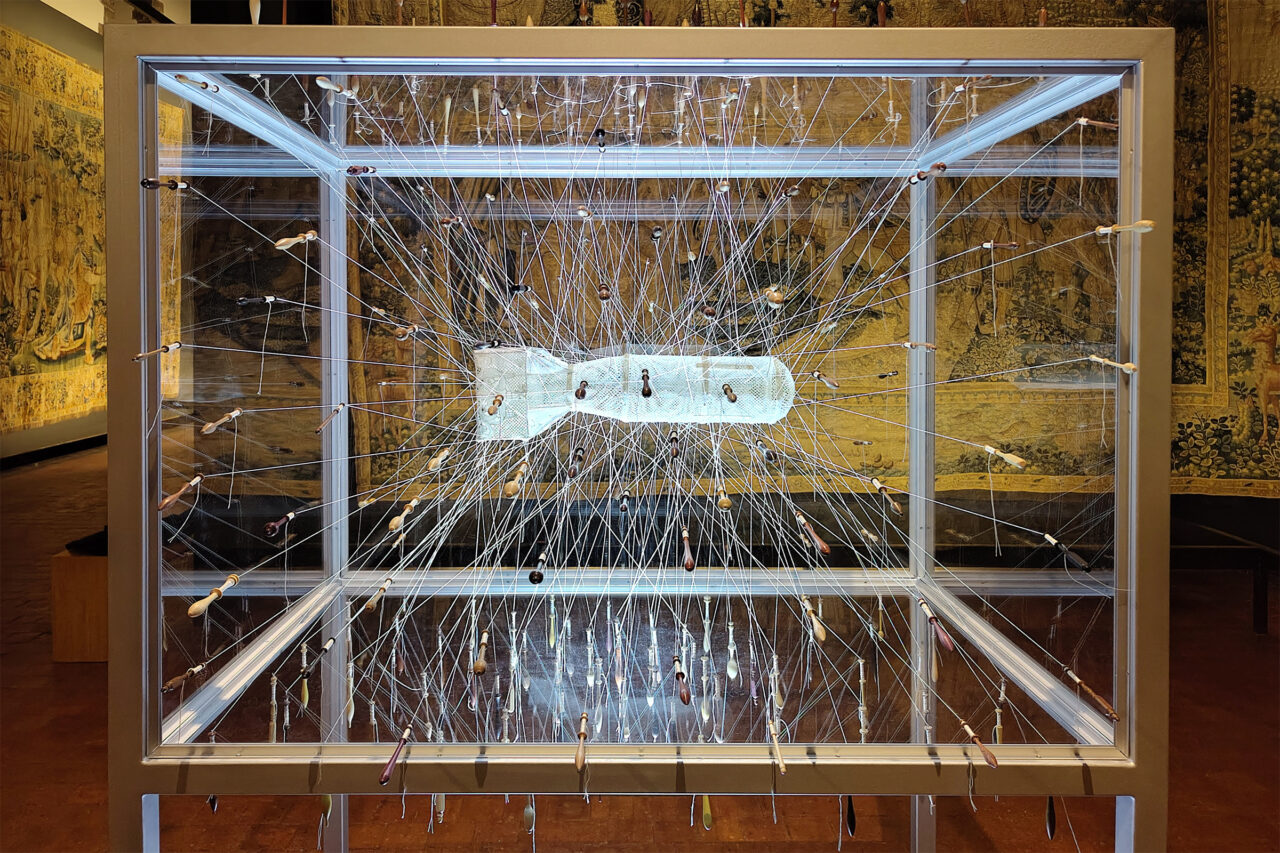
Little Boy 3D (2026) detail, MOU Museum, Oudenaarde, Belgium (photo: Maarten Vanden Eynde)
Little Boy 3D (2026) detail, MOU Museum, Oudenaarde, Belgium (photo: Maarten Vanden Eynde)


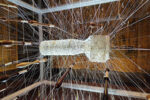
Little Boy 3D takes its name from the atomic bomb dropped on Hiroshima, Japan, in 5 BP. Most of the uranium used in the first atomic bombs came from the Shinkolobwe mine in Katanga, in what was then the Belgian Congo. It was shipped from Antwerp, Belgium, to the United States by Edgar Sengier, the director of the Union Minière du Haut-Katanga. A similar route was followed in the past by cotton. Enslaved people transported from the Kingdom of Kongo planted and picked cotton in America’s southern states, whence it was shipped to the cotton mills of the United Kingdom and also to Belgium and the rest of western Europe to be used, for instance, in the bobbin lace industry. That is not the only tragic link between the histories of cotton and uranium. When the Second World War broke out, Japan was one of the world’s major cotton producers, and dropping Little Boy and Fat Man heralded a definite end to the cotton empire of Japan. Little Boy 3D was made in collaboration with Ulrike Dehaeseleer, Ingrid De Dobbeleer, and Rita Van Cotthem, three highly skilled bobbin lace experts, who spent nearly 1000 hours on its creation. The 250-plus wooden bobbins are all unique pairs, referencing the many hands that helped create the atomic bombs in the Manhattan Project. Shaped like bullets or bombs and radiating outward, they seem suspended mid-trajectory, heightening the installation’s explosive force.