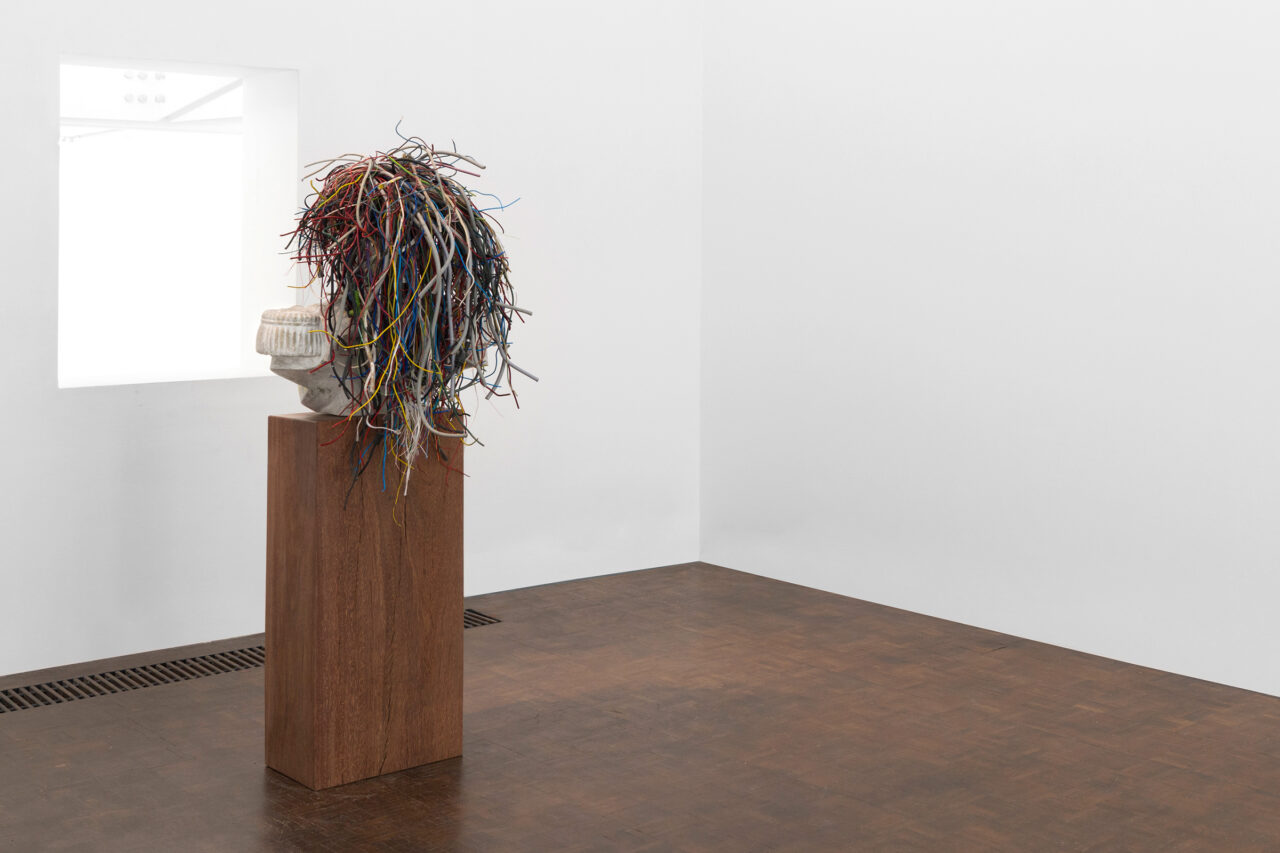
Error 404 (2026), Meessen gallery, Brussels, Belgium (photo: Alice Pallot)
Error 404 (2026), Meessen gallery, Brussels, Belgium (photo: Alice Pallot)
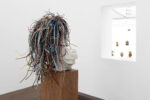
The first transatlantic cables connected the United States with Europe and increased the speed of communication and trade exponentially in the second half of the 19th century. Rubber and copper were the key ingredients and both were extracted in large quantities from the European colonies, including the Congo Free State (now DR Congo). The cables still overlap with the old shipping routes that were used during the slave trade. Error 404 consists of an official plaster portrait of King Leopold II with a chaotic cluster of data cables and electrical wires running from the back of his head. The work recalls both a medical procedure gone wrong, like a brain scan in overdrive, and an explosion of technology coming from the now brainless sovereign, who never went to his own Kingdom. Although digital technology and increasingly advanced Artificial Intelligence exist 'out' there, intangible in the cloud, they still make use of rubber- and plastic-coated copper cables, in addition to a humongous amount of cobalt, lithium and other (rare) earth minerals to operate. The bust with a technological Afro coupe is placed on a massive block of azobé — an exotic wood that is so heavy that it doesn't float but sinks straight to the bottom — looking through a window at a collection of masks (Leopold's Ghost, 2026) that seem to resemble his own image.