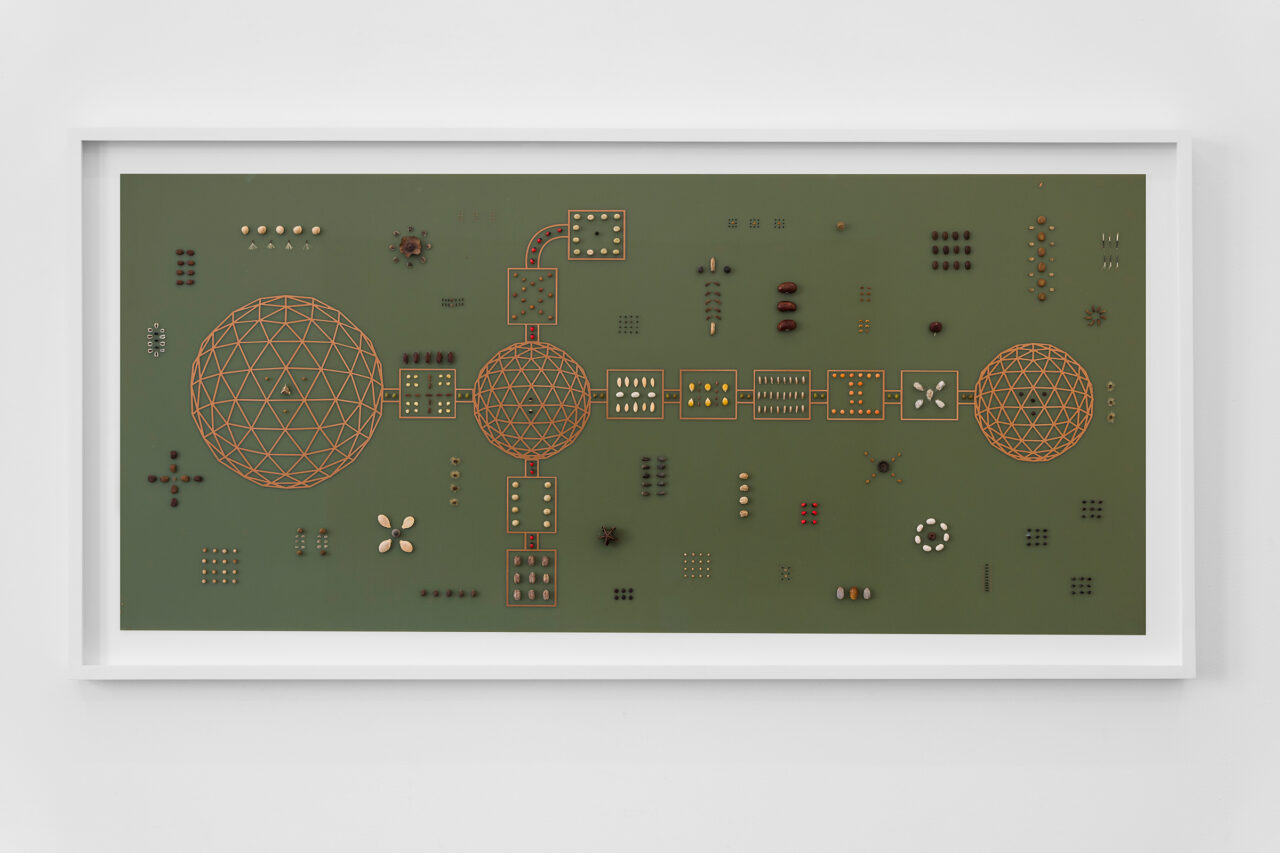
Future Flora: LUNA (2026), Meessen gallery, Brussels, Belgium (photo: Alice Pallot)
Future Flora: LUNA (2026), Meessen gallery, Brussels, Belgium (photo: Alice Pallot)
Biodiversity is in dangerous decline in both the animal and plant kingdoms. One of the ways in which the survival of as many different plant species as possible is attempted, is the creation of gene banks in seed vaults and time capsules. In 2008, Norway opened the Svalbard Global Seed Vault, which stores a collection of duplicate samples, or ‘spare copies’, of seeds held in gene banks around the world, as a backup in case of regional or global disasters. In 2018, the collection surpassed one million samples, comprising more than one-third of the world’s most important food crop varieties. However, rising temperatures are more severe in the Arctic, causing the first floods in 2016. Future Flora: Luna depicts the Doomsday Seed Vault that is scheduled to be built on the moon. It combines the blueprints of the imagined seed storage, visualised as a copper circuit on large-scale PCBs (printed circuit boards), with a wide variety of seeds collected from different parts of the world. Together they make up a huge lukasa, or memory board, reminiscent of those used by members of the Mbudye association in the Kingdom of Luba (now part of the DR Congo) as an archive for the topographical and chronological mapping of political histories and a means of remembering important people, places and mythical migration routes. Their organisation on the circuit board mimics transistors and other electrical components that are mounted on PCBs. They allude to seed collection, preservation, modification and militarisation.