Water, sea, oceans. For centuries, they have been a major source of inspiration for artists and designers worldwide. The many faces of water and its impact on contemporary fashion and art lie at the heart of ‘High Tide’. For its latest exhibition, Musea Brugge brings together fashion and contemporary art on this scale for the first time in Bruges, conceived by fashion curator Karen Van Godtsenhoven, in a fluid and surprising dialogue.
A sensory journey that inspires wonder
High Tide shows how fashion and art can help us look at the sea with fresh eyes. They invite us to feel, reflect on, and marvel at our relationship with water at a time when this vital connection is under greater pressure than ever before. The exhibition is a sensory journey through fashion and contemporary art, enriched by video, sound, and heritage. A journey that inspires wonder, moves us emotionally, and encourages reflection, dialogue, and a sense of connection. Not only with the beauty and power of the sea, but also with our own place within it.
Rediscovering the sea
High Tide invites visitors to rediscover the sea. Not as a distant horizon, but as a living world of which we ourselves are a part. The exhibition unfolds as a contemporary odyssey through the oceanic imagination. The journey begins at the water’s edge, where land and sea meet. From there, the route leads through twelve thematic islands that together form an archipelago of stories. Just as the tides shape the rhythm of the ocean, ebb and flow also give structure to the exhibition: from the calm of low tide, through the mysteries of the deep sea, to the pressing urgency of high tide.
The many faces of water
Along the way, visitors encounter the many faces of water: as a source of life and creative power; as a mythical realm inhabited by goddesses and sea monsters; as a mirror of our emotions, desires, and dreams; but also as a space of trade, migration, extraction, power, and conflict. The North Sea occupies a special place within this story. For centuries, it has shaped the rhythm of Bruges and its surroundings. It transformed the city into an international trading metropolis, inspired generations of artists, and remains today a powerful symbol of the bond between our low-lying country and the sea.
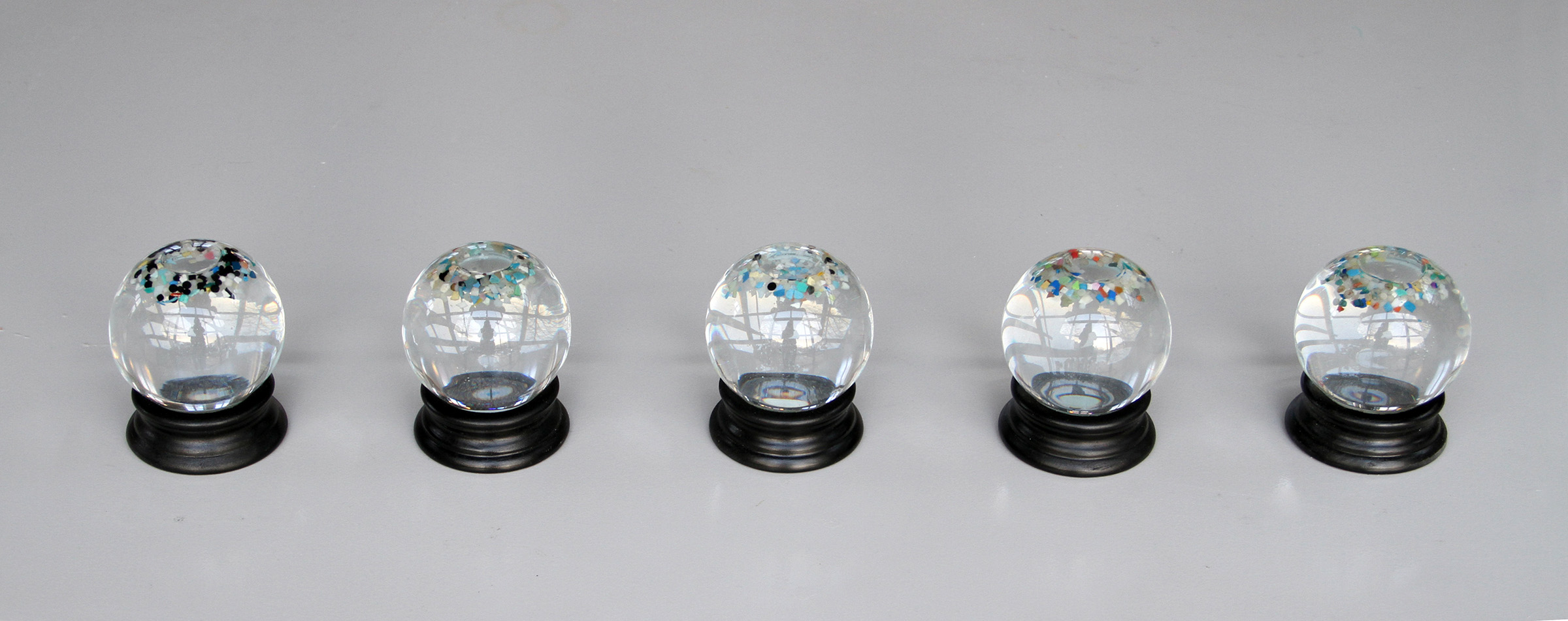
Maarten Vanden Eynde, 1000 Miles Away From Home (2009-2013).
'1000 Miles Away From Home' consists of five snow globes representing the five major oceanic gyres where the circular pattern of currents causes plastic debris to accumulate. Each snow globe is filled with microplastics, tiny plastic particles collected from the North and South Atlantic, the North and South Pacific and the Indian Ocean over the course of five years. Microplastics are one of the most underestimated global threats to the environment and our own health, so it is preserved here in a universally recognised tourist souvenir – a time capsule for the future. Shaking the globe creates a micro-gyre in the water, making the plastic swirl around.