Found is the second part of the trilogy Lost and Found – Caring for What Is (about to disappear). The exhibition has been curated by Tine Hens, author of Archief van mogelijk verlies (EPO, 2025). It brings together stories about larks, glaciers, fireflies, and elms from her book, along with carefully selected pieces from the library collection and the work of contemporary illustrators such as Jan De Kinder, Carll Cneut, and photographer Linde Raedschelders. The result is a stimulating dialogue between past and present, between science and imagination, between reality and fantasy, between discovery and loss. Collection items in the Book Tower bear witness to a diverse and abundant living world that was once commonplace but now seems extraordinary. Cookbooks, herbals, atlases, herbaria, studies of fish, mosses and fungi form an archive of possible loss and a dam against collective amnesia. The exhibition embraces the sadness of what has already been lost, invites wonder, but also depicts the causes of all that loss and the traces we leave behind, whether we want to or not. Through Frans Masereel's woodcut of the Milky Way from Die Stadt, visitors enter a world where Guido Gezelle wrote an ode to the stuffed animals in the museum of the Minor Seminary in Roeselare, where trees stand that died as victims of climate change due to drought, forest fires and salinisation, where sea monsters populate the oceans in Gerard Mercator's atlas, where Georges Cuvier, upon discovering the fossilised lower jaw of the mastodon, realises that species can become extinct.
Special attention is given to the drawings of European plants, butterflies and insects by Maria Sibylla Merian (1647-1717), who was the first to describe the intimate connection between flowers and their pollinators. As an artistic project and a link between living and paper heritage, her plant world will blossom in the courtyard of the Book Tower after the exhibition has ended. But the exploration of the natural world, as evidenced by travelogues and beautifully illustrated floras, also went hand in hand with colonisation, plunder and exploitation. We are still drilling deep into the earth's layers to feed and accumulate human wealth. It is a contrast and a tension that visual artists Maarten Vanden Eynde and Lola Daels reflect on. And then there is the question of the heritage of later times, of what remains and seems indestructible. Groping, searching, the exhibition opens a window onto tomorrow. For the first time, the Mondkapmeeuw (Mouthpiece Seagull) from the “Dead animals with a story” section of the Natural History Museum Rotterdam is on loan. Next to Leo Baekeland's original article on the development of bakelite are “plastiglomerates”, new stones created by the fusion of plastic and minerals. As a provisional archive of a possible legacy.
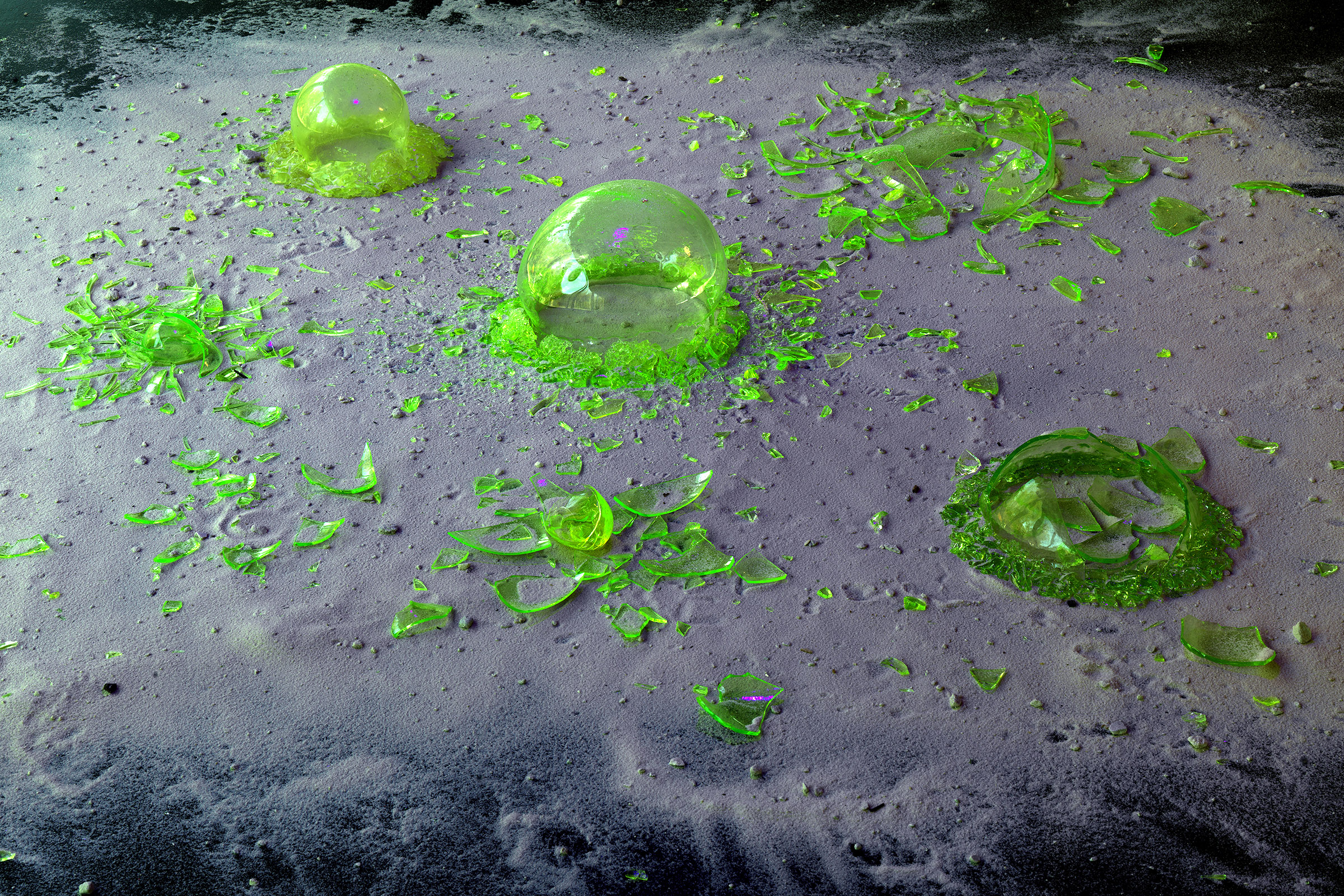
Maarten Vanden Eynde, Manhattan Project (2017).
'Manhattan Project' is a model of several tests – successful and failed – to recreate the perfect dome that occurs 0.025 seconds after an atomic bomb is detonated. Antique uranium glass, sometimes known as ‘Vaseline glass’, was melted and blown to form a perfect bubble to imitate the miniature explosions. Before it was used to fuel nuclear power plants or produce atomic bombs, uranium was employed as a colouring agent in the manufacture of tableware and household items. Yellow or light green in colour, it fluoresces bright green under UV light. The white sand, which comes from the White Sands Missile Range, where the first atomic bomb was exploded, covers the bottom of the dome and becomes phosphorescent purple, completing the macabre but also wondrous model.
The detonation of the first atomic bomb may be agreed upon as the event that marks the end of the Holocene and the start of the Anthropocene, the age in which human activity is the dominant influence on the planet. From that moment, radioactive isotopes such as strontium-90 start to be present in the geological layer that we are now creating, representing the perfect ‘golden spike’. A ‘golden spike’, more formally called a Global Boundary Stratotype Section and Point (GSSP), is a marker in the environment created by a global event that leads to long-lasting global changes signalled in the geological record and which can be said to epitomise the start of a new geological epoch.